2008-07-08

xf86-video-cyrix and xf86-video-nsc: it's dead, Jim

It had to happen sooner or later:

The X.org drivers for the old GX1 variants of the Geode chips formerly made by Cyrix and NSC no longer build against the current X.org release. Given the imminent release of X.org 7.4 (server core 1.5), this essentially means that users of older Geodes will have a nasty surprise, the day they upgrade to Ubuntu/Intrepid, which ships with core 1.5. Soon after, the release immediately following Debian/Lenny will be affected too.

There is a planned milestone to eventually reintegrate support for older GX1 products into the clean and up-to-date xf86-video-geode framework, but this will unfortunately come too late for those upgrading to Ubuntu/Intrepid, unless...

...unless someone volunteers to copy gx_* files inside xf86-video-geode and graft GX1 support into the resulting gx1_* files. If you have access to Cyrix/NSC GX1 + CS5530 or AMD SC hardware and a reasonable knowledge of the X.org codebase, your contribution would be most welcome.

2008-06-25

O: planner -- project management application

This one had been a long time in the making, but here it goes: I'm orphaning Planner. Why? Because upstream hasn't been too active in ages, save from a few random bug fixes, and because the GCC 4.3 transition at Debian has exposed yet more bugs that make it FTBFS. The package had been marked as RFA for a while, but I decided that I'm not gonna wait any longer; O it is. Hopefully, an experienced GNOME maintainer will take over and revamp the upstream code into a usable shape. If not, then I guess we just found another dead package in the archive. So be it.

2008-06-20

HOWTO build a clean LTSP boot image that includes the latest updates

Thanks to Oliver Grawert and Michael Haas for this idea!

  1. Check your LTSP server's sources.list

    Ensure that the server has the relevant APT sources to fetch the latest updates:

    deb http://security.ubuntu.com/ubuntu hardy-security main universe restricted multiverse
    #deb-src http://security.ubuntu.com/ubuntu hardy-security main universe restricted multiverse
    
    deb http://fi.archive.ubuntu.com/ubuntu/ hardy-updates main universe restricted multiverse
    #deb-src http://fi.archive.ubuntu.com/ubuntu/ hardy-updates main universe restricted multiverse
    
    deb http://fi.archive.ubuntu.com/ubuntu/ hardy main universe restricted multiverse
    #deb-src http://fi.archive.ubuntu.com/ubuntu/ hardy main universe restricted multiverse
    
    deb http://ppa.launchpad.net/q-funk/ubuntu hardy main
    #deb-src http://ppa.launchpad.net/q-funk/ubuntu hardy main

    In this example, the Finnish Ubuntu mirror for the Hardy suite is used. Change this as necessary. Notice that all source package lines are purposely commented out.

  2. Build a boot image using that sources.list

    Build the image using the following command:

    ltsp-build-client --copy-sourceslist --accept-unsigned-packages

    This builds the image using the repositories found in the server's sources.list. Accepting unsigned packages is necessary, because the PPA is not digitally signed.

The above method is a good way to check what would happen on a clean install, if any particular package were updated to a newer proposed release that is currently sitting on someone's PPA.

Enjoy!

HOWTO make Geode thin clients work on Ubuntu/Hardy LTSP

As summarized by Ace Suares, to validate my first rough upgrading instructions:

  1. Upgrade the packages in the LTSP chroot

    First become root:

    sudo chroot /opt/ltsp/i386

    Then add the repository, update and upgrade:

    echo "deb http://ppa.launchpad.net/q-funk/ubuntu hardy main" >> /etc/apt/sources.list

    apt-get update && apt-get upgrade && apt-get clean

    APT will inform you that some packages cannot be authenticated. This is normal, since the PPA is not digitally signed. Simply answer Yes.

  2. Purge the transitional AMD driver

    apt-get --purge remove xserver-xorg-video-amd

    Then, exit the chroot:

    exit
  3. Update the LTSP boot image

    sudo ltsp-update-image

    On a 64-bit server, the correct command is:

    sudo ltsp-update-image --arch=i386
  4. Profit?

Happy Midsummer, everyone!

2008-06-16

xf86-video-geode: now with full OLPC support!

Freshly uploaded to Debian: xf86-video-geode 2.10.0. Asides from a slouch of bug fixes, this version finally includes complete support for features unique to the OLPX XO-1.

Enjoy!

2008-06-06

Kuradne Geode draiveri!

Yes, another post about the Geode drivers. After much head banging, I finally figured out that the sloppy method used to generate the list of supported PCI ID for each driver in Debian and Ubuntu is what wreaked havoc with the GEODE driver:

  1. Support for the GX2 chipset was backported into the old NSC driver, which created a PCI ID conflict with the official support that is present in the GEODE driver.
  2. To make matters worse, that damn NSC driver also conflicts with the older CYRIX driver that supports earlier versions of the Geode chipset.

To fix both issues, I have produced new NSC and GEODE packages and uploaded them into my Ubuntu PPA for the Hardy series.

Tip: as soon as you have upgraded, purge the -amd transitional package; it only confuses the X server and disrupts operation if you leave it there, especially inside an LTSP chroot. If you were using a static xorg.conf, simply upgrade the Device line to use "geode" rather than "amd" and you're done.

After upgrading to these packages, normal operation should be restored for all Geode variants. As a bonus, X should now even be able to work without an xorg.conf (of course, with the wrong keyboard map, unless you live in USA) and in all known LTSP variants.

Enjoy!

2008-04-08

updated ALSA driver for early PowerPC hardware

Risto Suominen contacted me recently, after seeing my Ubuntu wiki page where I try to document what works and what doesn't using ALSA on PowerPC hardware. He has developed a patch against the snd-powermac driver that mainly support 603, 604 and G3 PowerMac hardware, to implement better support for several old Mac models. He was wondering where he could find testers for his work, so I offered to blog about it here. You can find his diff and patching instructions on his website. You can contact Risto to report on your testing's result using firstname.lastname@gmail.com

2008-03-09

Estonian ICT conference, March 18th 2008, TOBB Plaza, Istanbul, Türkiye

I previously wrote about my visits to Turkey to develop our export market in the Middle-East and how I ended up representing the whole Estonian business world in bilateral negotiations with Turkey. I'm going there again for two weeks, this time accompanied by a whole business delegation headed by Estonian prime minister Andrus Ansip.

Asides from various official events organized by our Turkish hosts to present Turkey to their Estonian guests, the crux of the visit is a conference hosted by DEIK and the Estonian embassy, on Tuesday, March 18th. The goal of this conference is to present Estonia's extremely advanced use of ICT technology in E-Business and E-Governance. Speakers from several private and public sector organizations will explain how they benefited from Estonia's hyper-connected lifestyle and, most of all, how this has made every Estonian's life more pleasant, because it offers a convenient way of performing a broad range of online transactions not just with businesses, but also with governmental organizations.

Yours truly will speak about the advantages Estonia offers to investors and technology freaks alike, from the perspective of an industry insider who, given the opportunity of choosing his first pick for a liberal high-tech nation, dropped the Nokiaesque lands of Suomi to go Eesti.

The morning of conference will end with a business lunch where interested Turks can network with their Estonian counterparts and create lucrative bilateral opportunities.

Space in the TOBB Plaza auditorium is limited so those interested in attending should promptly contact DEIK to get their name added to the guest list.

Turks interested in learning more about Estonia in their own language should visit estonya.net.

2008-02-05

Rumor has it...

...that Skype might be willing to port the Linux version of their application to Pulse Audio, as long as they get all the help they need to make this a quick and painless process. Rumor also has it that yours truly will have a visit from a Skype insider tomorrow at 13:00 EET to discuss this issue and, hopefully, be in a position to point the insider to a member of the PulseAudio community willing to guide them through this process. Rumor also has it that volunteers who contact yours truly on time to announce themselves might improve this port's chances of actually happening.

2008-01-24

ThinCan + LinuxBIOS = cool LTSP hardware

At the dayjob, we're currently clearing our warehouse of previous hardware to make room for upcoming new models, so here's a shameless plug for those who want cool Linux hardware at a discount:

ThinCan DBE60

Hardware: AMD Geode SC2200, 64MB RAM, 32MB DiskOnChip Flash, 3x USB 1.1 ports, 1/8" audio out, Centronics port, VGA port, 10/100baseT network port.

Firmware: Etherboot or WinCE 4.1 RDP client.

Price: 50 EUR/each - less shipping costs - Minimum order: 10 pieces.

PS: we also have about 50 pieces of DBE60 motherboards (without case) that can be used as embedded controllers. People with good soldering skills can add a CompactFlash socket to the unpopulated pads, as desired.

ThinCan DBE61C

Hardware: AMD Geode LX700 with CS5536 companion chip, 256MB RAM, 4x USB 2.0 ports, 1/8" audio in and out, VGA port, 10/100baseT network port.

Firmware: Etherboot on LinuxBIOS. Supported natively since Ubuntu/Gutsy.

Price: 150 EUR/each - less shipping costs - Minimum order: 2 pieces.

Interested parties can contact us via the request form.

Re: xf86-video-amd: patched xserver-xorg-core available

I previously wrote that:

The next step is to produce patches against the X server 1.4 in Debian/Sid and Ubuntu/Hardy, and then get the fix merged into the upstream X.org tree before X server 1.5 is released.

Good news: Bryce Harrington produced patched X server 1.4 packages for Ubuntu/Hardy!

The LTSP and OLPC communities are hereby invited to test this ASAP. If nothing major is reported, this will be become the standard X server 1.4 for the Ubuntu/Hardy LTS release, following which the patch will also be merged into Debian/Sid.

2008-01-21

xf86-video-amd: patched xserver-xorg-core available

Great news: After several weeks of investigating, Bart finally figured out what made the driver for the AMD Geode GX/LX chipset fail on recent X.org servers: it turns out that, starting with X server 1.3, changes under the hood took place that affect a number of products booting off a General Software BIOS, making the whole hardware freeze as soon as a DDC probe is attempted. Bart promptly produced two patches against the x86emu component of X server 1.3 that fix the issue. Hurray!

Ubuntu/Gutsy packages of the patched X server 1.3, plus current AMD 2.7.7.5 drivers, are available in my PPA.

For Debian/Lenny, the same packages compile from Ubuntu sources as-is. Meanwhile, those of you running Debian/Etch only need to compile the Ubuntu sources for the above AMD driver against the X server 1.1 available in Etch.

This should finally allow people developing distributions for LTSP or for the OLPC to use standard Debian packages.

The next step is to produce patches against the X server 1.4 in Debian/Sid and Ubuntu/Hardy, and then get the fix merged into the upstream X.org tree before X server 1.5 is released. We're already working on it, but help is always welcome.

2008-01-13

xf86-video-amd from OLPC not for public consumption

Holger reported in his blog that he uploaded a backport of the AMD Geode GX/LX X.org module to Debian. He also points out that what he has backported is from a non-Debian source. In case it wasn't obvious to him, there are good reasons why the official Debian module is not from the OLPC branch: the OLPC branch includes OLPC-only code that breaks operation for non-OLPC hardware. This means that the backport package is completely useless for the vast majority of GX/LX hardware on the market. Well done, Holger!

2008-01-03

Hunting for a new laptop (part 2)

Earlier, I had reported on my quest for a new laptop. To recap, I had narrowed down my choice to an LG model whose 12.1" 1280x800 WXGA display and ATI Mobility Radeon X1250 graphic chip failed to be recognized by the Ubuntu CD. Back then, my initial tests were performed using a Feisty CD. Since then, I have returned with a Gutsy CD and got equally disappointing results: E: screen found, but none offers a usable configuration.

Some people suggested buying a laptop with an all-Intel chipset. While Intel chipsets are indeed the best-supported in the business, largely because Intel invests its own resources into coding Linux drivers for all of its products, products based on Intel chipsets tend to be double the price of those based on VIA motherboards with ATI graphic chips. Seeing how quickly hardware devaluates on the market, it feels rather unjustified to pay such a fortune for an Intel-based product, only to see its market value cut in half less than a year later.

Here's a tip for AMD/ATI marketroids: invest as much resources into coding GPL kernel and X.org drivers for all of your products as you did for the OLPC project and always do so a good 12 months before entry to market. Otherwise, prepare for bankruptcy, because companies like Intel who don't shun the Linux market will eat you alive.

Me goes back laptop hunting...

2007-12-28

O: planner -- project management application

While looking at outstanding bugs against my Debian packages, I noticed that an RC bug had crept in against Planner. The bug itself isn't new. In fact, Ubuntu had experienced it already and simply decided to build their package without SQL support to resolve the issue.

Planner is a fairly well-matured piece of software, with very few bugs remaining. It remains quite usable in everyday use. However, it has fallen behind in terms of keeping its code up-to-date against the latest versions of some optional dependencies.

Tonight, I was just sitting here pondering what to do and it occurred to me that I'm simply no longer interested in maintaining the package. I have done a fairly good job of overhauling the build scripts and of upgrading them for the Python transition but, at this stage, I feel that I've accomplished as much as I could do. Besides, I no longer have the time to maintain so many packages, so I have decided to focus on maintaining those I actually care for and Planner isn't one of them.

The package already is assigned to Debian's GNOME team, so no need to actually orphan it, since anyone from the team can pick it up. If you're a member of the GNOME team and feel like taking over, perhaps even submitting patches to upstream to close a few more bugs, go right ahead and jump in.

2007-12-22

Valga - Valka : 1 linn, 2 riiki - 1 pilsēta, 2 valstis

Thursday evening, I joined the inhabitants of the twin town of Valga-Valka, sitting smack on the Estonian-Latvian border, to celebrate their entry into the Schengen treaty. Ever since I first crossed the border there on a roadtrip from Tallinn to Fallingbostel, in year 2001, I knew I would have to return and, sure enough, I briefly passed through during last summer with an Estonian friend, on our way to an acquaintance's birthday party.

Still, that told me nothing of the town's life and left me wanting for more.

Upon hearing that year 2004 EU accession countries would join Schengen in December 2007, I immediately promised myself to show up and join the crowd. As it turns out, I missed Aleks Tapinš of the All About Latvia blog by very little, having I caught his last-minute e-mail the next afternoon. Aleks blogged a great article depicting the Latvian side of life and providing some background info on the town, if you're curious.

I arrived late-evening on Thursday via the Tallinn-Viljandi-Valga bus and checked into my hotel, then proceeded to checkpoint Valga II around 23:30, with the intention of grabbing a drink on the Latvian side and returning just before midnight for the celebrations. Hardly anyone was in sight, except for Latvian officer Čabana who was completing the inspection of a Russian car with three noisy passengers. Upon presenting her with my passport, officer Čabana cheerfully lead me to the office and slid my passport through a slot to officer Bukss, who was visibly surprised to have any tourist show up on the last day of his job to get their passport stamped. Upon explaining to him the reasons for my presence, he pointed me to a nearby bar where I could have a drink, visibly amused by the situation.

I spent the next few minutes in a local casino in the company of three hilarious Latvian truck drivers, Zintars and Aivars, two Latvians with limited English language skills and Yuri, an ethnic Russian living in Ireland who was born stateless on the Latvian side of the town and who later acquired Estonian citizenship by claiming ancestral land on the Estonian side.

Upon returning to the border, just minutes before midnight, I found myself in the middle of a huge crowd of villagers, police officers, border guards and politicians from both countries - barely getting noticed by anyone. I handed my passport to an Estonian border guard who emotionally commented to a civilian friend of his nearby that, "Wow! That was the last one!", handing me my passport back just as the midnight bells rang and the mayor of the Estonian side started his speech amidst pyrotechnics lining the road.

I then had a chance to chat with the Estonian mayor, who promptly handed me a bilingual certificate, signed by the mayors of both towns, attesting that I was the first to cross the open border, while introducing me to his two young daughters with whom he was about to take a stroll on the Latvian side.

The next morning, an even bigger and more symbolic event took place: the demolition of the fence that had been cutting the Sõprus/Raiņa street in half. You can see a picture of what the street looked like before on Aleks' blog article [edit: or on Jens-Olaf's blog article]. After the fence was removed, it instead looked like this:

The crowd then proceeded to checkpoint Valga III, where a stage had been setup for the politicians to make their speeches. An interesting fact is that, because of the way the border was drawn, along a creek leading to Pedeli river, an Estonian main road was technically on the Latvian border and thus aptly named "Raja" (border) street. The Estonian mayor commented in his speech that the the brand new supermarket standing behind us was also technically on borderland and could not have possibly been built earlier, weren't it for the Schengen treaty matter-of-factedly eliminating borders between participating EU countries. The speeches were closed by a youth group whose choreography featured six break-dancing boys, dressed as Estonian and Latvian border guards and as border posts. The choreography ended with the teenage border guards carrying away the human posts on their shoulders, just as a choir of young girls replaced them with songs in either languages.

Before catching my bus back to Tallinn, I dropped by the Valga tourist info, only to face a nervous-looking Kapo officer in plain clothes. Upon mumbling something about the tourist info and wanting to grab maps, I noticed that a press conference was taking place behind. As he finally let me pass to the tourist info side of the building, a familiar voice said to me, "Hey! Weren't you at our place last summer with Martin Ranna?" Yup, the wife of the acquaintance whose birthday party I had attended last summer is working there and greeted with me refreshments and munchies she had cooked in prevision for the presidential visit! As was my luck, she had one of the commemorative plaques that had been given to the politicians at Valga III on hand:

I was glad to see the town becoming one again, even though it is ethnically divided. There are already signs of people on both sides learning one another's languages and shopping on either side of town, not to mention plans of merging the municipal bus operations of the Estonian and Latvian halves of the town, so I'm sure that they'll get there in due course.

For me, Schengen brought a much more practical and quite welcome change: the end of messy border crossing stamps that were rapidly filling my almost new passport, every time I visited the head office of our company in Tallinn. While Estonian border guards mostly stamp passports in an orderly fashion, being careful to fit exactly 8 stamps in a single page and to put entry and exit stamps side-by-side, Finnish border guards apparently are incapable of doing so, instead systematically wasting pages by either stamping sloppily in a way that makes it impossible for more than 4 stamps to appear on a given page or by flipping to a brand new page, every time I had to cross the border.

In case anyone ever wondered why I'm currently representing Estonian interests abroad, despite living in Finland, this example is one of the many reasons: Finnish authorities routinely display arrogant carelessness towards the population and doubly so towards immigrants. It amounts to an accumulation of idiocy that has costly consequences on people's lives. For some, it's about being denied the public institutions' support when they need it the most and their life forever going downhill thereafter. For me, it has been about countless missed opportunities (jobs, love affairs, travel plans), plus very costly passport and residence permit renewals. Given this, I simply don't see myself ever representing Finnish interests ever again. Faith no more. Besides, the Estonians are fun and easy-going people. Siski ma mõtlen, kas ma peaksen nüüd Eestisse kolima või?

2007-12-12

Ubuntu on an LG E200 laptop?

As my aging ThinkPad is starting to show signs of an impeding retirement, I recently began looking for a newer laptop to replace it. My current choice would be for an LG Electronics model E200-A.CPPPV laptop. However, when trying an Ubuntu Feisty live CD on it, X failed to find any usable screen resolution and aborted. Thus I was wondering if anybody had better results using a Gutsy CD? In principle, the hardware should be supported, since it's all Intel and ATI components but, these days, you never know, especially with graphic and wireless chipsets. Comments?

2007-11-16

Miscellanea

Things have been rather hectic lately, so I haven't found much time to blog. Here's why:

DBE62

The Gigabit Ethernet version of our thin client took more time to produce than I expected, for a number of reasons mostly related to a few improvements we decided to squeeze into the design at the last minute.

However, today, we finally reached a point where LinuxBIOS runs as well as it did on our previous DBE61 model and where we no longer need any DOS tool to flash the MAC address into the VIA velocity Gigabit chip we selected. Hurray!

Production will only commence in one month, but I'm already excited by the new model's potential, both as a thin client and as an embedded platform.

Another good thing is that, thanks to Ubuntu developer Scott Balneaves, we managed to get all the necessary tools to support thin clients based on LinuxBIOS into LTSP, so our Etherboot model works out of the box on Ubuntu, since Gutsy. Hurray!

There is one remaining issue related to recent changes in X.org core functionalities that make the AMD driver we need unstable but, again, various AMD, Debian and Ubuntu developers are looking into fixing this, so we should soon have spotless Geode support into Debian and Ubuntu again.

Türkiye

I visited Turkey twice over the last few months, because I'm putting together a pilot project to better promote the Estonian high-tech sector abroad, in collaboration with the Estonian government.

I have to say that the more I visit Turkey, the more I like the place and the more understand why these people see themselves as Europeans because, you know what? They are: practically every significant civilization and religion that is at the core of European culture had major events taking place in in Anatolia or Thrace and, also, a devastatingly huge percentage of the consumer goods sold in Europe are designed and manufactured in Turkey.

Learning the rudiments of Turkish has also proven to be a lot of fun. While I'm nowhere near as fluent in Turkish as in Finnish or even in Estonian, the learning curve isn't as steep as I initially expected: Altaic and Ugric languages share a surprising amount of grammatical concepts, while Turkish itself borrowed a lot of vocabulary from French, because the founder of modern Turkey, Atatürk, was very fond of the language. I'll venture that proximity with nearby Middle-Eastern countries that were formerly under French influence has something to do with it too.

Identity crisis

To me, the most challenging part of these business missions abroad is to represent a whole economic sector from a country of which I'm not a citizen or even a resident. Case in point:

Being invited to dinner by a Turkish investor, I noticed the waiter asking my host where his foreign guest might be from. A few minutes later, as the waiter put down a gigantic pita bread with the word "Estonia" spelled in roasted sesame seeds, my host asked, reading my business card:

  • Actually, your name doesn't sound Estonian. France?
  • Québec.
  • And your mobile number ... 358 ... is that Finland?
  • Yup. I've been living there for the past 10 years.
  • Ah! So you don't live in Tallinn?
  • Nope. Helsinki.

Looking at the waiter and pointing at the gigantic pita, he continues:

  • Actually, make that Canada ... no, Finland ... Ah, sorry, never mind. Just keep it as Estonia.

Honestly, trying to keep a straight face while saying "We" about a country of which I'm not a citizen and where I don't even reside becomes unbearable. At some point, some European bureaucrats will have to admit that I need a new citizenship, to reduce the confusion and to let me find myself a proper national identity again; the sooner, the better.

Besides, the absurdity of the situation keeps on jumping at everyone's face: during the second mission to Turkey, I kept on bumping into Finnish diplomats who took personal offense at me for living in their country and yet representing the interests of a competing, neighboring country. If you ask me, I cannot entirely blame them for it.

However, as far as I'm concerned, I've done my homeworks: I've been here 10 years, I speak the language and I don't have a criminal record. Given this, you'd think that acquiring citizenship would be a mere formality, but the Ulkomaalaisvirasto doesn't see it that way.

If you ask me, this country's very first Minister of Immigration, Mrs.Astrid Thors, ought to unilaterally grant citizenship to anyone who's lived here for at least 5 years, just for the asking, regardless of what circumstances brought them here or of what absurd decisions the Ulkomaalaisvirasto might have previously made on their residence permit status. Doing this would go a long way towards undoing the mess of her predecessors at the Ministry of Interior and it would speak volumes about how much Finnish society has evolved from the days when any foreigner was a commie they had to push over the Eastern border.

2007-08-14

Sound editors that work with Gstreamer or PulseAudio?

Today, I wanted to edit a few MP3 files into suitable ring tones for my phone. The idea seemed simple at first: load up a song, chop off a few bars and loop that as a ring tone.

Nice in theory, except that sound editing software on a free desktop is challenging, at best: most of it was designed back in the days of OSS and GTK 1.2, some wants to use JACK for playback, while the most recent crop indeed supports ALSA but insists upon having exclusive access to the ALSA device.

Dammit! My understanding was that, with Gstreamer and PulseAudio, the free desktop had finally acquired a comprehensive, standardized sound framework, but not many applications seem to support it — or is there something I have missed?

2007-08-12

Fresh out of NEW university: mkelfimage

I maintain the Debian package of mkelfimage, a tool to produce Etherboot images for use with thin client environments such as LTSP, which recently entered the Debian archive.

The key difference between mkelfimage and the aging mknbi is that mkelfimage does not reply upon any traditional BIOS call to produce the bootable code in the ELF image, which makes it possible to boot thin clients with LinuxBIOS as their firmware, such as the Linuterm and several other products designed by Artec.

mkelfimage accomplishes its BIOS-less operation using a simplified kexec implementation. However, this also means that explicit support for each architecture must be implemented with Assembler code. As it currently stands, the upstream tarball only includes support for i386 and ia64. Since amd64 boots in 32-bit mode, it should also work there, but this is untested.

This leaves support for several architectures completely uncovered for. LinuxBIOS developers have taken over the upstream code and they welcome patches towards improving support for other architectures and towards cleaning up the autoconf implementation currently in use.

GR: Debian Maintainer

Rumor has it that the General Resolution on acknowledging the concept of Debian Maintainers (mere participant who are granted limited upload rights, just enough to freely work on their own packages) has passed. I'm wondering what sort of timeframe we're looking at for deploying the infrastructure needed to manage this and then start accepting requests to be added to the separate GPG keyring. Would anyone know?

Telling Network Manager to prefer home AP?

I'm running Network Manager on my Ubuntu laptop. It's a really neat tool when it comes to selecting an open wireless network when traveling, but it has one major flaw: you cannot tell it to prefer some "homebase" among a swarm of available Access Points; it insists upon using the first AP it finds, regardless. Has anyone figured out a solution to this common situation?

Meanwhile, the OpenVPN front-end that Network Manager offers only covers a fraction of available parameters, which means that I cannot use it to connect to my dayjob's LAN from outside the company, because the few Windows clients we have connecting to it expect a VPN to work in a specific way and cannot adapt to non-Microsoft approaches to VPN concept, which means that we Ubuntu users are the ones who have to adapt. Thus, the OpenVPN front-end would need to be able to configure MTU, MSS and other arbitrary parameters supported by OpenVPN. Looking at various BTS, I notice that I'm not the only one who needs this. Are Network Manager developers listening? :-)

2007-07-28

Localisation beyond language packs

In my previous post, I briefly mentioned my K750i Sony-Ericsson mobile phone. I received it as a birthday gift this year, to replace my aging but trustworthy Nokia 3210 and, as with any multifunctional digital device, there was a learning curve during the adoption period. While some features were gladly and swiftly taken into use, some of the handset's usability issues became my pet peeve and, among them, the localization pack wins the jackpot.

First, let's make one thing clear: I fully understand that memory constraints prevent manufacturers from including support for every language known to man, so a handset can only be loaded with a limited set of languages for the User Interface and for T9 predictive text input dictionaries. My issue is with the concept of grouping languages by linguistic families or continental areas, when compiling the localization packs for those handsets.

In this particular case, I had a choice between the Baltic or Nordic packs. The former has UI language support for Estonian, Latvian, Lithuanian, Polish, Russian and Ukrainian, while the later has support for Finnish and the Scandinavian languages; English is also included in both cases. T9 support is a strangely mixed bag: the Baltic pack only includes predictive input for the Slavic languages, while the Nordic pack supports all the languages of its UI.

What's my problem with the above language combinations? For starters, I'm in Finland. We don't interact with Danes or Icelanders outside very occasional pan-Nordic meetings and that mostly concerns politicians. Meanwhile, average Finns travel for work and play to Estonia and Russia on a fairly regular basis, which makes sense, since they are neighboring countries. However, available language packs don't take this into account.

How should this be resolved?

Either language packs are produced with specific countries in mind, rather than generic geographic areas, or the users should be allowed to freely mix and match among all available languages and get the result flashed into their handset at purchase time.

The K750i language pack for Finland should therefore include: Finnish, Swedish, Estonian, Russian, English and Norwegian (essentially the current Nordic language pack, but with Danish and Icelandic replaced with Estonian and Russian). Then again, this only covers official state languages. Samé dialects, anyone? I guess not, because we'd soon be exceeding the handset's capacity. Hmm...

Thus, the only real solution is to allow people to freely mix and match UI and T9 languages of their choice at purchase time.

As a bonus, this would allow me to drop Norwegian and replace it with Joual... ööö... cålisse, French and finally have a language pack that I can truly find useful. I can easily picture a Transylvanian engineer working in Finland wanting to get Romanian support or a Kurdish immigrant preferring Turkish support instead.

Sony-Ericsson, how about it?

Dear lazy Fluendo

Surely there must be a way of using gstreamer0.10-fluendo-mp3 to produce MP3 files using Sound-Juicer, so that I can listen to my favorite albums on my Sony-Ericsson phone while commuting to work via the Helsinki-Tallinn ferry, but how?

2007-06-25

Crazy idea: shipit.debian.org

Over the last few days, I have had to perform a number of clean installations, some using Debian, some using Ubuntu. Whenever handing over freshly OEM'ed hardware, I like to include a copy of the CD media to the customer, as a courtesy.

This works extremely well for Ubuntu, from whom it is possible to order official release CD. Customers always get a nice buzz out of that.

For Debian, though, I always get embarrassed looks over the home-burnt CD, because it projects a lack of professionalism. Enterprise customers want a commercially pressed CD and they want it to be the official one published by Debian; explaining to them that Debian doesn't publish pressed CD media produces an instant lack of trust in Debian. What can I say? It's their perception and, as the old saying goes, the customer is always right.

This got me thinking, why doesn't Debian have its own ShipIt like Ubuntu? Granted, Debian is a non-profit organization, but surely that would not prevent selling official CD media to help cover at least some of its operational expenses, now, would it?

One way to implement this would be to hire the exact same CD pressing plant that Canonical employs to handle their CD ordering and shipping logistics. They already have the procedure and tools in place to handle this; they just need to add a branded version of that ordering site for Debian's needs and to receive official ISO files from Debian's Release Manager every year or so. How about it?

2007-06-17

Economics explained with cows

Economics explained with cows is probably one of the best-written example of economic models explained in simple terms. A must-read!

Recommended Listening: Ishkur's Guide to Electronic Music

Today feels something like the ideal to spend a Sunday afternoon: sorting though my Deviation Watch inbox and ... listening to Ishkur's Guide to Electronic Music. All I can say is WOW! This has got to be the single best compendium of electronic music I've seen in a long time. The explanatory texts are quite spot-on too. Well done, Ishkur!

Thanks to Elver for brightening my day with the URL to this guide!

2007-06-15

Dear Skype morons

Dear morons of the Linux development team at Skype:

In case this wasn't obvious to you, beta releases are not to be uploaded to a Stable package repository; they instead go to an Unstable or Experimental repository.

This detail is of critical importance, given how your current 1.4 Beta has totally crappy audio (1.3.0.53 was at least usable, while 1.4.0.74 definitely ain't) and it also misses features that were present in 1.3 Gold.

So, would you have the courtesy of putting 1.3.0.53 back into the Stable repository and of creating a separate Unstable repository for your beta, instead of pushing unpolished crap where people expect rock-solid software?

PS: please be honest and remove that claim about Skype having superior audio quality from the package description. As far as audio quality goes, Ekiga beats you flat out and it already has video support too.

2007-05-27

How about a Gaim of talking Pigeon?

Today, getting increasingly tired of the incoherent User Interface in Gaim 2.0 release candidates, I fetched the recently uploaded release 2.0.1 of Pidgin (same software, different name; the result of a trademark dispute) from Debian/unstable and built it against Stable dependencies.

First impressions: excellent harmonization of the behavior between supported protocols, thanks to a new user status handling that is common to all protocols, coupled with unified a icon theme. Overall, this feels much more consistent in everyday use and it serves to blur the distinction between protocols to maintain the focus on the conversation taking place.

However, two major annoyances:

  1. The old behavior of stealing focus, every time a tab pops open, is still there. AAAAAAAAAAAAAAAAAAAAAAAAARRRRRRRGH!
  2. Extremely tiny fonts in the conversation window and trying to make them inherit the default system font size via Pidgin's built-in GTK plug-in simply fails.

Conclusion: libpurple may be technically amazing, but Pidgin really is in desperate need of a complete UI overhaul.

2007-05-24

Almost there: granny-friendly PDF writing

One aspect of Ubuntu that I really enjoy is the sheer amount of constructive feedback a maintainer gets about the usability of their packages. In my case, CUPS-PDF [1] [2] has been a landmark example of how beneficial this feedback can be:

See, one long-standing goal at Ubuntu has been to include the capability to generate PDF documents "out of the box" and regardless of which Desktop Environment is used. Many people considered that CUPS-PDF would be an excellent tool, but various technical issues prevented this from working in a security-conscious way. Once that issue was taken care of, someone pondered how the PDF queue could be automatically created at installation time?

It turns out that we're almost there: with the upload of version 2.4.6 into Debian today (which should propagate into Ubuntu within a few days), only one configuration step remains: the selection of a PPD driver. Everything else is automatically detected and configured by CUPS itself. Kudos to our friendly upstream, Volker, for implementing this driver magic in his back-end code! Enjoy!

2007-05-23

Bidding farewell to 32-bit computing

A number of recent events reminded me of how much time has passed since I started using Linux. Among these, the retirement of several 32-bit CPU architectures from the list of supported platforms on Debian and Ubuntu.

The first architecture to fall was m68k. Release Managers at Debian proposed to drop support for m68k after Sarge, which indeed happened: Etch was released earlier this month and, for the very first time in Debian history, without m68k support. Granted, a number of dedicated developers are working on porting the GNU toolchain to Coldfire (an embedded platform that supports about 80% of the m68k instruction set) and good chances are that they will succeed but, let's not fool ourselves: m68k is gone.

Around the same time, Ubuntu dropped support for PowerPC, just before releasing Feisty. Granted, there is still some PPC64 hardware being manufactured, but this is on the server side and thus getting farther away from the desktop market that constitutes Ubuntu's core business. Of course, given the plethora of 32-bit PPC hardware in circulation, in the form of second-hand Power Macs, the platform still has some lifespan left but, again, let's not fool ourselves: PowerPC is gone too.

And now, a message sent to Debian mailing lists suggested that, as of Linux kernel 2.6.21, support for 32-bit SPARC was broken and, due to an insufficient developer interest for maintaining the GNU toolchain, 32-bit SPARC was likely to be dropped for the Lenny release. Yup, we really cannot fool ourselves: support for 32-bit architectures really is gone.

Not surprisingly, my own computer collection has followed a similar trend: this morning, my beloved PA-RISC host left for the home of a happy computer hobbyist who had won the online auction on it. My Atari TT030 is likely to follow a similar route fairly soon. Ditto for the exotic Atari Stacy sitting besides it ...and let's not mention the huge stack of Pentium II and K6 desktop hardware sitting in the corner.

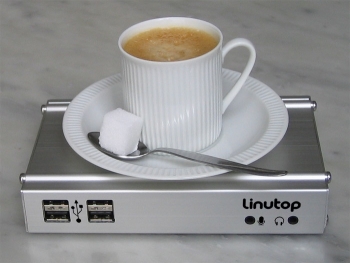
Looking back, I'm glad to have shared so many brilliant years with 32-bit hardware. The variety of CPU architectures and hardware designs was quite a learning experience. This being said, life goes on and my current needs are fully covered by my Linutop and by my aging ThinkPad.

Thank you for all those years, 32-bit computers. Enjoy a well-deserved rest in bit heaven.

2007-05-21

Adventures in Business Setting

One funny thing about being a foreigner is the linguistic choices people make when communicating with me. Case in point: my new job at Artec.

This being Estonia, there's a plethora of languages to choose from: Estonian, obviously, but also Russian, English and Finnish. Russian is possible because 30% of Estonians are ethnic Russians (or related Belorussians and Ukrainians) whose ancestors were relocated during Soviet times. Russian also remains strong as a language of trade, especially among the older generation, while English tends to replace it for the younger generation. Then, Finnish is widely spoken in Northern Estonia, because of Tallinn's proximity to Helsinki and despite Southern Estonian being linguistically closer to Finnish.

People's choice, whenever discussing work-related matters with me, varies accordingly: some prefer to use English while, for others, Finnish comes naturally. Then there's a handful of older collegues who feel uneasy speaking either English or Finnish, so they address me in Estonian, placing special care on clearly articulating every word and on speaking at a slower pace than normal (to Finnish ears, Estonian essentially sounds like Finnish on fast-forward and with unusual choices of vocabulary).

I have yet to see anyone try Russian with me, although a few people have noticed that I get the overall idea, just as long as they articulate clearly and speak slower than normal. Then again, our ethnic Russians are so well integrated that they speak Estonian all day long, even among themselves, and I have been able to observe the same pattern everywhere I've been in Estonia. From that perspective, I think that Russia's claims about "oppression of ethnic Russians in Estonia" are greatly exaggerated.

2007-04-09

Reboot

I guess one could summarize Easter as a certain prophet's big reboot?

Now, make it funky!

Yup, this Easter, I completely rebooted as well: after briefly visiting my relatives in some distant country that some morons insist I should call "homeland", I got back to my real homeland in the HELish land of singing demons for a full reboot: new job, new home, new girlfriend.

Then, my computing resources rebooted too.

Shake it to the Left! Shake it to the Right!

Reboot your life.

2007-03-23

I'm Thin, therefore I Can

Life sometimes goes in a funny direction, like a full circle déjà vu: 20 years ago, I was studying Technology of Computerized Systems (a combination of electronics and programming). Now, 20 years later, I'm starting a dream job as the Business Development Manager of Artec Group and their core business is — you guessed it — exactly that. The really cool thing about Artec, from a Free Software advocate's point of view, is that they contribute firmware and drivers for their products to LinuxBIOS and the Linux kernel.

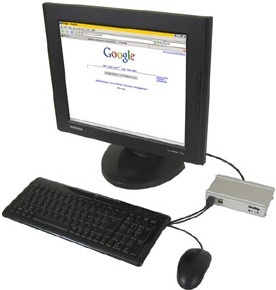
At this point, my initial tasks will focus on marketing and selling Artec's flagship OEM product, the ThinCan. What is the ThinCan? Actually, you're already familiar with one iteration of the product: the Linutop is a branded ThinCan, delivered with a custom hardware configuration, plus custom casing artwork designed by Frédéric Baille of Linutop SARL and loaded with Fred's favorite Xubuntu configuration. In the Linutop's case, their business model is to fill the market niche for a simple Internet surfing platform that fits 80% of average people's daily computing needs, so the hardware configuration they ordered reflects that.

Still, as several readers of this blog noticed, the "Linutop" could make a fantastic thin client and, sure enough, that was the main purpose behind the ThinCan's original design; it sells well in the Fortune-500 market as an RDP client running under Windows CE. However, until recently, there simply wasn't much demand for a contemporary X11 terminal solution based on the ThinCan. That is, until LTSP took off, thanks to the contributions of Edubuntu and similar educational Linux distributions. Sure enough, someone spotted the opportunity and contacted Artec to order a branded ThinCan iteration with Etherboot and PXE support, which they call the Linuterm.

By the way, for those who need a really cheap OEM thin client, I've got a great spring clearance offer for you:

Artec has about 500 pieces left of their older DBE60 ThinCan model, based on the AMD Geode SC2200, and we're selling them at 100 euro / piece, plus VAT and shipping.

The DBE60 is configured with three USB 1.1 ports, one parallel printer port, one 100baseT Ethernet port, one VGA port (up to 1024x768 @ 16bpp 60-85Hz or 1280x1024 @ 8bpp 60-75Hz) and one 1/8" stereo audio output jack. Its BIOS provides Etherboot support and its motherboard is populated with 64MB of RAM and 32MB of Stratoflash. It comes delivered with a European AC adapter. The Geode SC2200 is fully supported by the Linux kernel — with the sole exception of a missing ALSA snd-scx200, but this could easily be ported from AMD's deprecated OSS driver — and X.org support is provided by the "nsc" driver.

Minimum order size is 10 pieces. Contact me via my full name (unaccented, with one hyphen and one dot) at artecgroup.com quoting this special offer.

PS: someone was asking if that DBE60 special is also available in the aforementioned Fortune-500 configuration. It indeed is: add 16 euro / piece for the Windows CE 4.1 license with an RDP client.

2007-03-20

Linutop: Order Yours Today!

Fred informs me that we now have our ordering system up and running so, for those of you who had been longing for their very own Linutop, do visit us and fill out the order form.

Please note that, at this stage, we are only able to ship within Europe. However, if anyone is interested in distributing the Linutop on other continents, we definitely want to hear from you.

2007-02-24

Linutop: Use the source, Luke!

I recently blogged about putting together the Linutop source code ISO. The resulting image has now been uploaded to our wiki. The ISO's content is divided in two sections:

  • Debian source packages for all the software used on our reference platform.
  • Linux kernel source with our custom kernel configuration and kernel patches.

Developers who are interested in producing customized OS images should download this ISO and consult the wiki for details on developing for the Linutop.

2007-02-15

Free Software annoyance: Gaim

Dear Lazy Web:

I am developing a severe hatred of Gaim 2.0, because some of its dumb features hamper my productivity. Are there any simple configuration tricks that could fix the following issues:

  • How can I make Gaim stop auto-hiding its conversation windows?
  • How can I make Gaim stop auto-toping its dialogs and windows?
  • How can I make Gaim stop stealing the focus all the time?

Would you happen to know the answer to any of the above?

Best Regards,

Mr.Linutop

2007-02-06

Tip of the day: fetching all Debian source packages

A few weeks ago, the Linutop team received a request for its source code. We had already anticipated the GPL source offer clause in our development plan, so it was just a matter of myself getting around producing a source code ISO image. Piece of cake, right?

Almost. You see, Linutop includes a custom kernel package and several separate wireless module packages, so the the following command would not work as expected:

apt-get --download-only --ignore-missing source $(dpkg --get-selections | cut -f 1)

Why is that? Because APT ignores the --ignore-missing option whenever executing the source command. Instead, Roland Mas suggested that I used this simple Bourne loop:

for p in $(dpkg --get-selections | cut -f 1) ; do apt-get --download-only source $p ; done

Done this way, the source code of each package is fetched individually and, if any package's source is not available, APT exits but the Bourne loop moves on to the next package in the list. Nifty, isn't it?

2007-01-29

Linutop à Solutions Linux, Paris, La Défense, 30 janvier au 1er février 2007

Linutop will makes its first public appearance tomorrow at Solutions Linux in Paris. French developers who are interested in getting their hands on one of our 50 development units should call up Fred at 0685868576 and schedule an appointment. Others who just wanna see the Linutop in action are welcome to drop by booth D 16 during the exhibition.

Meanwhile, rumor has it that someone else might be dropping by Montréal for the February meeting of FACIL with a mysterious Free Software -powered aluminum box...

2007-01-22

UTF-8 Migration Tool now in Debian unstable

I previously blogged about UTF-8 Migration Tool, a GTK2 wizard that helps users upgrade their legacy locale and recode text files to their UTF-8 equivalent. After merging a number of patches from Nicolas François to fix various parsing issues, I am now happy to report that the package has entered Debian's unstable distribution.

Plenty of migration cases remain untested, though, and the Debian i18n team particularly welcomes testing for locales that utilize a non-default legacy encoding or that contain an @modifier part.

If no major issue is found, the goal would be to release this package with Etch to help users migrate their system to UTF-8.

Do you want to take over CUPS maintenance in Debian?

Kenshi sent the following GPG-signed message to the Debian CUPS mailing list today:

Hi folks,

As you know, there are many bugs about CUPS including Release-critical and I haven't an enough time to fix them.

My primary motivation was to internationalize/localize it. Now it is already implemented by upstream.

Unfortunately CUPS is too complex for me to maintain. I haven't a time to track bugs, I haven't an enough knowledge about Postscript or printer specific codes, and I haven't any testbed of user's printers.

If you'd like to become primary CUPS maintainer instead of me, I pass a baton happily :) Of course I'll support you such as uploading.

Thanks,

Interested parties should contact kmuto directly to manifest their intention.

2007-01-12

Copywrong: Media Moguls versus Artists

One recurrent theme in discussions about Copyrights and Digital Rights Management is that the Media Industry allegedly represents the interests of the Artists. Yet, recent actions in Canada and elsewhere prove that Artists who benefited from the wider exposure of their creations via the Internet in fact oppose laws that would preserve and further entrench the monopoly of the Industry.

Finland's case is no different: as reported by Jaakko Kuivalainen in the Tekijänoikeuslaki blog [in Finnish], a number of Finnish Artist Coalitions are currently opposing the transfer of copyright issues from the Ministry of Education (who also handles cultural affairs) to the Ministry of Commerce, because they fear that the interests of the Media Industry would suddenly have precedence over those of the Artists and small Independent Cultural Producers.

Yet another proof that, no, Media Moguls do not speak on behalf of the Artists.

2006-12-29

RFA: utf8-migration-tool -- Debian UTF-8 migration wizard

From the Debian Bug #374997 department:

* Package name    : utf8-migration-tool
  Version         : 0.4
  Upstream Authors: Tollef Fog Heen, Martin-Éric Racine
* URL             : http://q-funk.iki.fi/debian/pool/u/utf8-migration-tool/
* License         : GPL
  Programming Lang: Python, GTK2+
  Description     : Debian UTF-8 migration wizard
This wizard upgrades legacy system locales to their UTF-8 
equivalent. It also informs users whenever files in their 
home directory still utilize legacy encodings.

This started as an Ubuntu tool to enable easy migration to UTF-8 for both locale settings and user file encodings. Tollef says that since Ubuntu has been UTF-8 by default for a few releases already, they are not likely to further develop it and invited me to take over development, so I have.

I have found this tool very useful to help me locate remaining files in my home directory that are still in a legacy encoding and to check system files for UTF-8 locales utilization.

Given how Etch is going to be the first Debian release with UTF-8 locales by default, I figure that it could be a useful migration tool for others as well.

Since I'm currently paring down my involvement in Free Software, I never got around fixing the GTK annoyance reported by Denis Barbier in response to the ITP and thus never uploaded the package to the NEW queue so, if anybody is interested in picking up this package's maintenance, please do so by responding to the above bug.

2006-12-25

Life after Etch

This week, following the announce of the freeze, I upgraded most of my home cluster to Etch. The upgrade went surprisingly smoothly, although I had a bit of a scare when the kernel upgrade pulled in a bunch of dependencies that resulted in the forced removal of all previous kernels. This minor scare asides, kudos to everyone who made this new Debian release possible!

My only disappointment about Etch is that we're stuck with Firefox 1.5.0.7 instead of 2.0.1 or Iceweasel. Then again, speaking of Iceweasel: Forget it! Breakages it introduces have been marked as pending or patched for a number of weeks and yet there's still no updated package. At this rate, better wait until Etch r1 or Lenny to introduce it, rather than release Etch with a browser fork that has not undergone several months of thorough testing!

This got me thinking about life after Etch, or more specifically, about what I'm gonna do with the packages I maintain. The Dunc Tank debacle and similar other unfortunate events that overtook Debian this year have prompted me to reevaluate my motivation. Another unrelated issue is, I've been working in software development for more than 10 years and my guts are telling me that it's time to move on so, while my computers will still run on Debian or Ubuntu, I don't intend on doing any more development per-se.

Thus, I have already taken the initiative of soliciting co-maintainers for most of my packages. The Debian GNOME team agreed to be added for Planner, which is nice given the sheer number of bugs that are regularly found against this package. CUPS-PDF, Gaim-IRChelper and NumlockX haven't seen a meaningful bug in ages and can be rebuilt using bin-NMU magic, so they're pretty much taken care of. This leaves the issue of the Estonian and Russian dictionaries (plus a large patch in my personal repository that would upgrade Aigars' Latvian dictionary to generate the Aspell wordlist from his MySpell wordlist) open. For these, native speakers that develop for Debian or Ubuntu would be welcome to join me.

What next? I have a couple of interesting offers, one on the Business side of computer hardware manufacturing in Estonia and another one as the manager of a western company's Latvian office. The tricky part in either case would be the immigration process: despite close to 9 years of living right here in Europe, I am still perceived as foreign labor whose hiring must be thoroughly justified (in the case of Estonia, I even need to request an explicit exemption to the immigration quotas), whereas if I had been granted EC Long-Term Resident status or Finnish citizenship, I could just sign the contract and notify the local authorities of my change of address. Instead, 9 years later, I'm stuck at the passport control queues for non-EU citizens with its disgustingly suspicious border guards. Sigh!

Thus, while I indeed have shares in Linutop (yes, we are finally shipping - stay tuned for details) that might eventually turn into gold, I also have close to zero motivation left in my personal life, because lingering European bureaucrazy prevents my talent from reaching its customers - turning all my attempts at having a career into a neverending series of bitter disappointments. Is it any wonder that I'm so adamant about getting out of the Rat Race to return to more gratifying creative activities like composing and photography, then?

Post Scriptum

Actually, there is a second disappointment about Etch: we are stuck with Evince 0.4.0, at a time where upstream just released 0.7.0 with strong recommendations that everyone upgrade to that. Heck, even Ubuntu has 0.6.0 already. I find the Evince situation way more annoying than the Firefox one, because, from a user's perspective, Evince 0.4.0 fails to display several PDF documents that more recent releases handle just fine.

2006-10-19

Linutop in Arvutimaailm and Eesti Ekspress

Yours truly appears this week in computer magazine Arvutimaailm [Estonian] and in the technology insert of newspaper Eesti Ekspress [Estonian], in feature articles about the Linutop. Both articles are signed by Elver Loho of the IT-Neeger team.

2006-10-09

ALSA pitfalls ... and a bounty ... or two

Daniel Jacobowitz writes about problems he's having getting proper ALSA support for his desktop computer. Boy, does that sound familiar!

I myself have three computers that are partially or totally unsupported on ALSA:

  • Apple iMac rev.D a.k.a. 333MHz G3 tray-loading iMac.

    Partially supported by snd-powermac, except that some controls are inverted and other controls just plain don't work. Probably something as simple as the wrong offset in the bitmap used to select the control on which to act. Bug filed in the ALSA BTS. No reaction.

    Anyhow, sound support for Apple products is being migrated to snd-aop, which was written from scratch using a modular architecture that enables easily adding support for new sound chips. Nice idea, except that no effort is being put towards supporting pre-G4 products...

    Back when Ubuntu appeared on the Linux scene, Mark Shuttleworth agreed to pay a 500$ bounty to whoever made ALSA work on all PowerMac variants. Nobody took it, as far as I know. Those who are interested in taking on this challenge might wanna check my wiki page for our summary of the ALSA PowerMac situation.

  • HP 9000 series model 712.

    Recently supported, thanks to someone on the PA-RISC Linux mailing list having a go at coding it. Never merged by upstream ALSA, though. It's been a while since I gave it a try but, last time, only output worked.

  • AMD Geode SCx200.

    There is no snd-scx200 driver at all. Bug filed in the ALSA BTS. The issue of sound support on early Geode products was also mentioned on the Linux kernel mailing list, during the big OSS cleanup discussion so, at least, some people are aware of the issue.

    It so happens that the Geode SC is used in a number of popular embedded boards, such as the Soekris and yet, nobody tried porting the old OSS drivers available on AMD's Geode driver source page. Odd.

As we can see, there's plenty of ALSA support remaining to be coded, ported or cleaned up, and some people are willing to pay for the results. Who's gonna grab it?

2006-10-08

Linutop - Internet for the masses

I promised last week that I would be telling more on October 1st, about the mysterious Project X that I had been sporadically blogging about over the last few months. Better late than never, so here's the story:

Casablanca

I met Morocco-based French entrepreneur Laurent Bervas via his blog in January 2006, while looking for countries nearby EU with a promising ICT market, because of growing obstacles in getting work in my field, due to my not being an EU national.

By the time the situation had reached the ridiculous extreme that friends were continuously loosing juicy recruitment bonuses, simply because their employer's HR department had issues with hiring non-EU nationals — despite EU policies that clearly favor foreigners married to an EU national — I figured that I ought to do something creative and see which of the countries bordering with EU might offer interesting opportunities.

Laurent was blogging about all the exciting opportunities he kept on seeing, since he relocated to Morocco to conquer the high-end Real Estate market. One day, he wrote about Morocco becoming a rising figure in the outsourcing business for the Francophone market, which prompted me to contact him. After a couple of weeks of discussion, he cautiously dropped his idea for a niche market he had spotted: a simple Linux-based set top box to surf the Internet. He then asked if I would be interested in developing it and in launching a startup with him to promote it. I gladly accepted.

Startup

That's when Laurent decided to introduce me to an old friend of his, Frédéric Baille, who spent several years at Compaq, culminating with a role in the team that launched the iPaq. Fred's help was instrumental in defining the market positioning of our product.

Laurent and I discussed the product features at length over IM and immediately agreed that the OS would be based on Free Software. That left the hardware part unresolved... or so did Laurent think.

Years ago, I briefly worked in the management team of an Estonian data security startup. This gave me the opportunity to network with several movers and shakers of the Estonian ICT. Among them was a promising ASIC and industrial design startup that produced really cool Thin Client hardware. The answer to our hardware needs, I figured, could easily be fulfilled by them.

My idea of contracting the hardware to Estonia was initially received with skepticism, so I made a simple proposal: why don't we hold the inception meeting in Tallinn and meet with the potential hardware supplier at the same time? Fred and Laurent accepted, so we spent part of April 2006 there, with me acting both as their friendly tourist guide and as the middleman for the introductions.

Fred and Laurent immediately fell in love with Tallinn's designer bars, omnipresent WiFi network and blond-a-plenty. Most of all, their visit at our potential hardware supplier gave them the answers they needed: Estonia is IT.

Overview

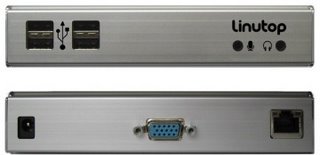
The hardware we selected is built around the AMD Geode LX, a nifty Pentium-compatible single-chip computer. It comes equipped with VGA output and four USB 2.0 ports, along with high-quality audio via 1/8" input and output jacks, plus a built-in encryption engine. We added 100baseT Ethernet connectivity (with provision for other networking options) to that, to complete the platform.

For the software part, we used ingredients from Debian's Etch release, focusing on a configuration that would enable easy access to the most popular applications for home and small business use: Instant Messenger (Gaim), Multimedia player (Totem), PDF reader (Evince), Web browser (Firefox), word processor (AbiWord).

The result is this:

Press Coverage

The editorial team at IT-Neeger (an A-level Estonian ICT blog) immediately scooped the story [in Estonian] and it produced such a strong response that the traditional Estonian media contacted the IT-Neeger team to write a feature article (stay tuned for details). The local Slashdot, Minut.EE, also reported [in Estonian] on the IT-Neeger article.

Thus, myself and Laurent Bervas spent the better part of this week being blogged, interviewed and podcasted by a variety of Estonian and French publications, which is how I only got around blogging this bit tonight.

Marketing

Contrary to our competitors, we fully intend on keeping this platform open, so our initial market will actually be Free Software developers with a penchant for innovation. As such, our first 50 units are exclusively intended for interested developers who want to improve upon our initial idea and participate in defining the final product. Inquiries are welcome!

2006-09-26

A: Internet for the masses

Q: What do you get if you combine

  • an A-level blogger with numerous commendable achievements in the Real Estate business and in the Software industry,
  • a business consultant whose outstanding success in selling his first computer game product later brought him to the business unit that launched the iPaq,
  • and a Creative Commons and Free Software advocate whose earlier ventures in the Music business resulted in appearances on two Gold records?

The answer on October 1st 2006.

2006-09-25

CUPS-PDF finally works on Ubuntu

For a long time, one of my Debian packages, cups-pdf, could not work on Ubuntu, because Ubuntu runs its CUPS daemon using a low-privilege user. I'm happy to report that this issue is finally resolved: following the release of CUPS 1.2, a simple solution was discovered by Andre Klitzing.

However, I only noticed this recently, after registering myself on Launchpad to respond to Ubuntu bugs affecting my Debian packages. Sigh! Perhaps notifying me earlier, via the Debian BTS, would have been a good idea?

Anyhow, after checking that the solution wouldn't break anything on the Debian side, I committed the fix to cups-pdf 2.4.1-2. Enjoy!

2006-09-24

meme: top ten UNIX shell commands

My results for this meme:

history | awk '{print $2}' | awk 'BEGIN {FS="|"} {print $1}' | sort | uniq -c | sort -nr | head -10
     73 sudo
     67 update-web
     53 ssh
     51 nano
     44 ls
     25 dir
     21 upgrade-daily.sh
     17 cd
     13 requestsync
     13 more

Among the more unusual sightings, update-web is a Bourne shell script to update my APT repository and synchronize my homepage, and upgrade-daily.sh is another one to upgrade my whole cluster in a semi-automated way.

Meanwhile, requestsync is a really neat Python script by Martin Pitt to request the synchronisation of Debian packages into Ubuntu, automatically fetching Debian changelogs and other relevant information to justify the request.

2006-09-16

Co-Maintainers Wanted

During Debconf5, I voiced the opinion that all Debian packages with a priority Standard or higher, as well as packages with a high Popularity Contest rating and development packages with a priority Optional or Extra that many people rely upon for development work, ought to be team-maintained as a matter of Policy. I justified this by pointing out that Debian's Social Contract puts our users among our key priorities, which implies that keeping the packages that our users value the most in excellent shape ought to be the embodiment of this value, and that the best way of meeting this goal is to enforce a policy of team maintenance and easy NMU for those packages.

While my own packages are rather modest contributions to Debian's pool and few of them rate anywhere close to the top in popularity, I honestly feel like practicing what I preach is the best example I could give. Another reason is that several business ideas that I'm working on are monopolizing my time, which means that I'm not as available as I would like to be to participate in Debian. I however see this situation as only temporary, which is why I have not orphaned my packages. Instead, I am soliciting Debian Developers to come as co-maintainers. Interested parties should check my QA page for packages that might interest them and contact me for details. Thanks!

PS: in case this wasn't obvious, the whole point of enforcing team maintenance and allowing NMU on non-RC but annoying bugs is to avoid unresponsive lone wolf maintainers who let tons of bug reports pile up on their packages without fixing them or even acknowledging them. Ubuntu avoids this by allowing anyone on their development team to chip in, while Debian still clings on to each maintainer's absolute reign over their packages, which leaves users of neglected packages completely in the dust.

2006-09-15

Linux 15th anniversary conference - September 4th 2006, Helsinki, Suomi

I meant to blog something about this for the last 2 weeks but other things had precedence. Anyhow, before this becomes hopelessly outdated, I decided to simply paste my notes verbatim, as a bulleted list. Here they are:

  • Lots of Ubuntu stickers visible on laptops!

liw: how did it all start?

  • Main areas of progress have been documentation and user applications, then distributions.
  • Installation improved from manual boot sector hacking to full GUI tool.
  • Linus purposely avoids working for distributors to preserve his neutrality.
  • Major kernel developments took place between 1992-1994 i.e. ports to m68k, alpha, powerpc.
  • Acknowledgement of RMS and ESR contributions to the Free Software agenda.

Maddog: changing, ruling and saving the world.

  • While at Drexel university, a teacher told him "No one will ever make a living writing software". Nowadays, the comment is rephrased about free software.
  • Parallel with 15-year olds that code amazing stuff being used for special effects, medical research, forensics, etc.
  • Parallel with what a 15-year old can learn from previous generations, from own early mistakes, from siblings, from dealing with bullying, etc.
  • In some countries, 15 is the age of consent or passage to adulthood.
  • Creative Commons embodies a society that enables read-write interaction.
  • Linux is already outselling Apple on the desktop.
  • Linux is shipping on over 1/3 of new servers.
  • The thin client market is completely Linux-based.
  • Social Networking and Peer Mentoring foster a creation of acceptance.
  • Malaysia's Computer Science graduates are 70% women and, surprise, it is a Muslim country.
  • Free Software enables localization for niche markets; this is a software freedom.
  • A shoe manufacturer that Maddog met on a plane had a domino Windows license upgrading effect that made him miss a whole production cycle. No longer supported Windows versions had to be replaced with new computers ...On which their custom software did not work anymore, while they worked fine on older Windows releases offering a DOS shell. He wanted to know how he could switch to Free Software and finally rid himself from slavery to Microsoft's licensing schemes that often impose costly hardware upgrades by turning previous hardware investments into unsupported obsoleteness.
  • Driving new standards are: FSG, ODF.
  • Generating local jobs adapting Free Software for local needs. The same cannot happen with closed-source software, because we're stuck with the vendor's limited offering.
  • Showing examples of excellent source code is the best way to teach programming. This is easily done with Free Software; not so with closed-source software.
  • The key to Free Software: have fun!
  • Remember: Software Freedom Day

This was followed by presentations from local Finnish players in the Free Software field. One point of interest: Timo Jyrinki, who is the founder of the Finnish Ubuntu community, emphasized that contributing to Ubuntu really meant contributing to Debian.

Videos are available (in Finnish, except for Maddog's presentation) on the server of the University of Helsinki. Sadly, the media format used is non-free... *sigh* When will they ever learn?

Clean Slate

There are moments in life when I keep on noticing that, no matter how much I try to keep up with whatever I missed while something else momentarily required my undivided attention, there simply is no way I can catch up. That's when a painful and yet eminently elegant solution imposes itself: discard and start on a clean slate.

Today was such a day.

Back a few months ago, when Deviant Art was crawling because of its outdated and blatantly inadequate infrastructure, I had to give up trying to keep up with the latest creations from my favorite Deviants. Recently, having heard that the infrastructure had been overhauled, I went back to have a look. Low and behold, nearly 6000 Deviant Watch notifications were waiting in my inbox! After spending a couple of days trying to catch up, reality dawned onto me: there's simply no way in hell that I can possibly skim through so many images. So, I used DA's nifty tool to delete all Deviant Watch notifications at once. There. Empty. No more deviation to review and therefore no endless white night ahead. Ah! Now, that wasn't so difficult, was it?

Granted, this wasn't so catastrophic. At worst, I missed a couple of truly remarkable works. Anyhow, those Deviants are gonna create yet more magnificent work, so I can rest safely knowing that the best of DA is yet to come. However, there have been other circumstances where the clean slate approach felt infinitely more painful:

Last year, the server which hosted my homepage and mailbox went belly up. Because the friends who own the server had more urgent matters to attend to, resuscitation had to wait for a couple of months. During that time, mail kept on piling up on their delivery host. By the time the server was back online, more than 7000 messages suddenly flooded my inbox. Again, same procedure: first spending nearly a week trying to skim through the From and Subject lines of the index, to attempt locating potentially important messages that needed an urgent though obviously belated response, only to realize that I simply could not make enough time to go through it all. The scary part is that I had been expecting various important messages during the blackout e.g. feedback from job interviews, certification test questions to answer within a specific time, etc. Still, someone can only stay awake for so many days before loosing focus, so I had to make the cruel decision to empty the inbox. Gulp! There. Gone. No more sleepless nights. Cross your fingers and hope you didn't miss any message of crucial importance...

There are yet more circumstances I can think of where the decision of starting on a clean slate imposed itself, despite the fear of perhaps missing out on something cool or important, or of giving up too soon despite clear signs of a dead-end coming. Eight years ago, my decision to relocate to a distant country that offered better career opportunities and a healthier lifestyle was one of those circumstances. What I'm carefully planning over the next few months is an equally important, though noticeably less dramatic step.

Still, I cannot help but wonder if I'm making the right choice?

Starting on a clean slate offers the obvious advantage of getting rid of dead weight. This is clearly a liberating sensation. However, it simultaneously requires letting go of elements that, despite their obsolescence or shortcomings, each contributed something useful at one point or another, which is very painful, because all those elements represent personal or monetary investments that often span several years. Think of retiring your very first computer, leaving your companion of many years or abandoning your homeland. Each element represents a lifetime of blood, sweat and tears, through shared learning experiences, through joy and pain. At the same time as you realize that it is now time to turn the page, you cannot help but remember the good times and yet wonder if you gave up too soon.

They call this perpetual state of reminiscence, growing pains. Ah! That explains it, I guess...

PS: I'd like to take this opportunity to thank the friends who used to host my homepage and mailbox, as well as the one who currently does. I might not often mention it, but rest assured that it's genuinely appreciated. I'd also like to apologize to all the Deviants whose great artwork I missed during the last few months and to anyone whose message got lost in the clean slate that followed the server crash last year.

2006-08-28

On entrepreneurship and Tallinn

Lars mentions in the same article that he is thinking about starting a business and that Tallinn is nice.

I agree.

Now, what if we combined both statements?

Not surprisingly, other Finns had the same idea, including former collegues of Lars and I, who took advantage of Estonia's outstandingly welcoming taxation laws, of Tallinn's luxurious variety of restaurants and coffee shops, of Estonia's comparatively more affordable cost of living and of the omnipresent country-wide wireless network.

Given this, is it any surprise that I keep on spending more and more time there?

Now, if someone on Toompea could only take a hint and realize that a québécois kes räägib eesti keelt natukane and who has been living for more than 8 years in the neighboring country very much is a local and ought to be equally welcome to immigrate as any EU national...

GNOME Network Manager annoyances

Having recently gotten around buying a WIFI card for the old ThinkPad 240x that my friend Marcus gave me and installed Dapper on it, I began to look for a simple method for selecting wireless Access Points. Someone on #ubuntu recommended network-manager, which I promptly installed. Well...

The NM version in Dapper wouldn't even cooperate with a common 8139too Ethernet card! First, it would correctly fetch the IP from the router, but then the network-manager-gnome applet would keep on spinning and only stop after resetting the IP to some 169.254.0.0 private network meant for Bluetooth and other similar networked consumer devices.

I then cautiously upgraded to Edgy, just enough packages to get a newer network-manager daemon and a 2.6.17 kernel, then tried again. Ah! It at least finally retained the dynamic IP whenever using the 8139too Ethernet card, but it still refused to connect to a wireless network whenever I switch to the DWL-G650 card. Hmm...

Just to check that the Atheros driver (AR5212 chipset appearing as ath0) was correctly loaded, I did a test by opening a terminal and manually setting the ESSID to the nearest Internet café's AP, using iwconfig, then launching dhclient3. Look, ma! It works!

Inspecting the logs revealed that connecting to a non-encrypted network with network-manager systematically fails, because NM bombards the Access Point with wpasupplicant, then sits there wondering why the AP doesn't request authentication, thus eventually reporting a failure to associate with the AP.

How do we fix this? Any Network Manager developer who is reading this that would care to comment?

2006-08-24

GTK2 coder wanted

I'm putting together a startup with some friends. Our product is based on diet versions of GNOME components. At this stage, the missing part is a diminutive control panel, to select the keyboard map (console + X) and to toggle between left/right -handed mouse (gpm + X). This could probably be extracted from GNOME components (e.g. capplets) as well, however keeping in mind the fact that we aim for GTK2 -only applications, to avoid unnecessary dependencies normally appearing with fully GNOME -compliant software. The result shall be published as Free Software, under a license matching whichever code the product was derived from. Our budget is small, but everything you code as a part of this project is immediately contributed back to the Free Software community. If this gig interests you, please drop by my homepage for my contact info and send me a summary of your skillset.

2006-07-18

Messidor doing Lanaudière?!

Evan, when you said "Saint-Michel-des-Anges" in this blog entry, surely you meant Saint-Michel-des-Saints?

PS: Maciej is wrong. What people speak in Québec is French, they just speak it with a heavy accent and curiously outdated vocabulary reminescent of their coastal France ancestry. Tabarnak!

USB mass storage support in Linux sucks!

After an extremely frustrating afternoon of seeing the Linux UHCI driver repeatedly shut itself down, following several successive I/O errors while accessing USB mass storage (a 512Mb Compact Flash connected via a USB card reader, in one case, and a 512Mb USB stick, in the other), I spent an even more frustrating evening surfing the Internet for a solution. Conclusion:

USB mass storage support in Linux sucks!

Several mailing lists and user forums report similar failures using USB 2.0 devices on Linux UHCI or EHCI drivers, down to the exact same error messages that I get. Some even report the whole USB subsystem going down, leaving the user without any keyboard or mouse on USB-only systems (this matches my findings on one particular hardware platform that happens to be at the core of a project I'm working on). The suspected cause, in all cases, apparently boils down to either or all these:

  • The SCSI subsystem upon which USB (and Firewire) mass storage is built is utter crap that would need a complete rewrite. The issue has been known for ages, it's even a proverbial elephant in the corner that nobody wants to see, but rewriting the subsystem for a standard that barely has any real-life application left means opening a big can of worms.
  • None of the Linux kernel's HCI are capable of anticipating the quirks present in some implementations of the USB hardware specifications, so they simply panic and commit suicide in syslog-flooding glory.
  • There is apparently a hard-coded limit of 1000 units (blocks?) that, when exceeded, will make the mass storage driver reset itself! Doesn't sound like Willliam Gates the Third's often-mentioned "Nobody needs more than 640k" now, does it?

I can feel for the average user who is just trying to extract a few pictures off a USB stick and who simply ends up reinstalling $commercial_os in frustration. Wasting a couple of days trying to debug support for what is supposedly a well-documented industry standard should never happen. There is no excuse for a broken USB mass storage on Linux. Let's fix it!

2006-06-18

Wengophone: VoIP done right

Via Free Software Magazine:

Dreaming about a free software competitor for Skype? Maybe your wait is over

And a very interesting alternative to Skype it indeed is!

Developed as Free Software by a subsidiary of the French telecom operator Neuf Cegetel, WengoPhone comes as either a Firefox plug-in or as a QT-based standalone application. On top of the VoIP features, it also supports other popular chatting protocols, for a seamless integration of all one's Instant Messenging needs.

Lovely! Now, when can we get a GTK2 version of that, messieurs?

2006-06-14

Planner 0.14 released

I had the pleasant surprise to notice that Planner 0.14 was finally released last night, more than a year after development had stopped, this time under the direction of Kurt Maute. I packaged it this morning and uploaded it to Debian's repository. There's still 9 bugs remaining and help is welcome towards clarifying whether they still apply to this new release. Enjoy!

2006-06-11

Retour sur ma semaine à Paris

In a nutshell: I'm extremely tempted to dump Finland and move to France.

6nergies

This business networking evening was simply amazing. How about a discussion on the phonetic niceties of Northern versus Central and Southern Vietnamese accents, as a conversation starter? How about another one, on ethnic versus national identities, as the icing on the cake leading towards a business card exchange? Lovely, isn't it? So was the girl...

Xin cám ơn, ông Mai!

I however had the nasty surprise of realizing that I no longer speak French to a native level, when Alain did my video profile. Oh, the hesitations...

Saaks mie puhuu suomee siinä videoesittelyzzä? Eiköha? Hä?

The Food

From Italian pizza to Japanese street noodles ― you name it, they have the real thing, cooked by expats. No way in hell you'll ever find that quality in Helsinki, especially not for that cheap!

The Book Heaven

France gave the world this wonderful language book collection called Assimil and the FNAC had them all... minus Le Lithuanien sans peine, whose publication appears forever delayed. Still, as Антон recently found out, they even offer material in languages other than French.

Combien vous gagez que le duc de Novgorod-la-Grande aura réussi à assimiler la langue de Molière avant Debconf7?

The People

Courteous, smily and easy-going; the exact opposite of the average Finn. What more can I say?

The Crossroad

Of course, resetting the citizenship counter to zero is not exactly my idea of fun, but then again I have a strong feeling that my 8-year venture into Finnish society has pretty much come to a full circle, so...

Y'a-tu quelqu'un dans la région parisienne qui cherche un commercial avec une forte expérience de la gestion de produits basés sur du logiciel libre et de l'exportation vers la Scandinavie et les pays baltes? En bonus: leçons de joual [en] [fr] gratis, tabarnak!

The Paradox

Visiting the South Karelia on the Senate Square event and feeling homesick for my adoptive hometown of Lappeenranta, as I kept on running into familiar faces who are still thankful after all these years that I dared become fluent in what they speak out East (which differs tremendously from normalized Finnish).

Isn't life ironic, sometimes?

2006-06-07

ALSA on the old GX1 Geode?

As I'm currently putting the finishing touches to "Project X", one remaining issue is ALSA support on the GX1 core inside the Geode SC2200. I'm just wondering if anybody out there implemented this already? Or perhaps someone would be willing to port AMD's old OSS driver to ALSA?

PS: I am fully aware that AMD considers the SCx200 series as an end-of-line product. However, given the plethora of GX1-based hardware out there, having an ALSA driver for it would still be worth the effort.

2006-05-25

Brightness control on an iMac G3 under Linux

I recall Linux/PPC kernel developer Benjamin Herrenschmidt saying ages ago that it would technically be trivial to write a tool that accesses the Open Firmware device tree to adjust the iMac's built-in monitor's features (brightness, contrast, geometry, etc.). I'm wondering if anybody ever coded such a tool? Otherwise, would anyone be willing to study the Darwin source code and port it to Linux?

2006-05-24

Networking à Paris

I'm spending next week in Paris, attending the last 6nergies event of this season, meeting business partners and interviewing with potential employers. If there's any Debian or Ubuntu developers that wanna meet for a drink and perhaps for an informal GPG key signing session, please drop me a line ASAP.

2006-05-19

Existential politics

Those who read French and who are interested in pondering issues where existential philosophy and politics intersect might find this article on my other blog stimulating.

2006-05-02

Alpha debian-installer bounty

From my good friend Eki:

I'd appreciate you informing people that I'm commiting a 100 euro bounty towards upgrading debian-installer images with MILO support for the Debian Etch release. I can personally help with development by testing the upgraded installer images on any of my 11 Alpha machines.

If you have MILO knowledge and are willing to produce updated debian-installer images for Etch and to submit your work to the debian-boot team, contact eki at his regular sci.fi account. Kiitos!