2007-06-25

Crazy idea: shipit.debian.org

Over the last few days, I have had to perform a number of clean installations, some using Debian, some using Ubuntu. Whenever handing over freshly OEM'ed hardware, I like to include a copy of the CD media to the customer, as a courtesy.

This works extremely well for Ubuntu, from whom it is possible to order official release CD. Customers always get a nice buzz out of that.

For Debian, though, I always get embarrassed looks over the home-burnt CD, because it projects a lack of professionalism. Enterprise customers want a commercially pressed CD and they want it to be the official one published by Debian; explaining to them that Debian doesn't publish pressed CD media produces an instant lack of trust in Debian. What can I say? It's their perception and, as the old saying goes, the customer is always right.

This got me thinking, why doesn't Debian have its own ShipIt like Ubuntu? Granted, Debian is a non-profit organization, but surely that would not prevent selling official CD media to help cover at least some of its operational expenses, now, would it?

One way to implement this would be to hire the exact same CD pressing plant that Canonical employs to handle their CD ordering and shipping logistics. They already have the procedure and tools in place to handle this; they just need to add a branded version of that ordering site for Debian's needs and to receive official ISO files from Debian's Release Manager every year or so. How about it?

2007-06-17

Economics explained with cows

Economics explained with cows is probably one of the best-written example of economic models explained in simple terms. A must-read!

Recommended Listening: Ishkur's Guide to Electronic Music

Today feels something like the ideal to spend a Sunday afternoon: sorting though my Deviation Watch inbox and ... listening to Ishkur's Guide to Electronic Music. All I can say is WOW! This has got to be the single best compendium of electronic music I've seen in a long time. The explanatory texts are quite spot-on too. Well done, Ishkur!

Thanks to Elver for brightening my day with the URL to this guide!

2007-06-15

Dear Skype morons

Dear morons of the Linux development team at Skype:

In case this wasn't obvious to you, beta releases are not to be uploaded to a Stable package repository; they instead go to an Unstable or Experimental repository.

This detail is of critical importance, given how your current 1.4 Beta has totally crappy audio (1.3.0.53 was at least usable, while 1.4.0.74 definitely ain't) and it also misses features that were present in 1.3 Gold.

So, would you have the courtesy of putting 1.3.0.53 back into the Stable repository and of creating a separate Unstable repository for your beta, instead of pushing unpolished crap where people expect rock-solid software?

PS: please be honest and remove that claim about Skype having superior audio quality from the package description. As far as audio quality goes, Ekiga beats you flat out and it already has video support too.

2007-05-27

How about a Gaim of talking Pigeon?

Today, getting increasingly tired of the incoherent User Interface in Gaim 2.0 release candidates, I fetched the recently uploaded release 2.0.1 of Pidgin (same software, different name; the result of a trademark dispute) from Debian/unstable and built it against Stable dependencies.

First impressions: excellent harmonization of the behavior between supported protocols, thanks to a new user status handling that is common to all protocols, coupled with unified a icon theme. Overall, this feels much more consistent in everyday use and it serves to blur the distinction between protocols to maintain the focus on the conversation taking place.

However, two major annoyances:

  1. The old behavior of stealing focus, every time a tab pops open, is still there. AAAAAAAAAAAAAAAAAAAAAAAAARRRRRRRGH!
  2. Extremely tiny fonts in the conversation window and trying to make them inherit the default system font size via Pidgin's built-in GTK plug-in simply fails.

Conclusion: libpurple may be technically amazing, but Pidgin really is in desperate need of a complete UI overhaul.

2007-05-24

Almost there: granny-friendly PDF writing

One aspect of Ubuntu that I really enjoy is the sheer amount of constructive feedback a maintainer gets about the usability of their packages. In my case, CUPS-PDF [1] [2] has been a landmark example of how beneficial this feedback can be:

See, one long-standing goal at Ubuntu has been to include the capability to generate PDF documents "out of the box" and regardless of which Desktop Environment is used. Many people considered that CUPS-PDF would be an excellent tool, but various technical issues prevented this from working in a security-conscious way. Once that issue was taken care of, someone pondered how the PDF queue could be automatically created at installation time?

It turns out that we're almost there: with the upload of version 2.4.6 into Debian today (which should propagate into Ubuntu within a few days), only one configuration step remains: the selection of a PPD driver. Everything else is automatically detected and configured by CUPS itself. Kudos to our friendly upstream, Volker, for implementing this driver magic in his back-end code! Enjoy!

2007-05-23

Bidding farewell to 32-bit computing

A number of recent events reminded me of how much time has passed since I started using Linux. Among these, the retirement of several 32-bit CPU architectures from the list of supported platforms on Debian and Ubuntu.

The first architecture to fall was m68k. Release Managers at Debian proposed to drop support for m68k after Sarge, which indeed happened: Etch was released earlier this month and, for the very first time in Debian history, without m68k support. Granted, a number of dedicated developers are working on porting the GNU toolchain to Coldfire (an embedded platform that supports about 80% of the m68k instruction set) and good chances are that they will succeed but, let's not fool ourselves: m68k is gone.

Around the same time, Ubuntu dropped support for PowerPC, just before releasing Feisty. Granted, there is still some PPC64 hardware being manufactured, but this is on the server side and thus getting farther away from the desktop market that constitutes Ubuntu's core business. Of course, given the plethora of 32-bit PPC hardware in circulation, in the form of second-hand Power Macs, the platform still has some lifespan left but, again, let's not fool ourselves: PowerPC is gone too.

And now, a message sent to Debian mailing lists suggested that, as of Linux kernel 2.6.21, support for 32-bit SPARC was broken and, due to an insufficient developer interest for maintaining the GNU toolchain, 32-bit SPARC was likely to be dropped for the Lenny release. Yup, we really cannot fool ourselves: support for 32-bit architectures really is gone.

Not surprisingly, my own computer collection has followed a similar trend: this morning, my beloved PA-RISC host left for the home of a happy computer hobbyist who had won the online auction on it. My Atari TT030 is likely to follow a similar route fairly soon. Ditto for the exotic Atari Stacy sitting besides it ...and let's not mention the huge stack of Pentium II and K6 desktop hardware sitting in the corner.

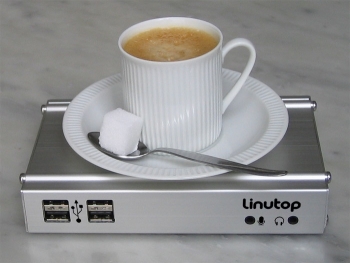
Looking back, I'm glad to have shared so many brilliant years with 32-bit hardware. The variety of CPU architectures and hardware designs was quite a learning experience. This being said, life goes on and my current needs are fully covered by my Linutop and by my aging ThinkPad.

Thank you for all those years, 32-bit computers. Enjoy a well-deserved rest in bit heaven.

2007-05-21

Adventures in Business Setting

One funny thing about being a foreigner is the linguistic choices people make when communicating with me. Case in point: my new job at Artec.

This being Estonia, there's a plethora of languages to choose from: Estonian, obviously, but also Russian, English and Finnish. Russian is possible because 30% of Estonians are ethnic Russians (or related Belorussians and Ukrainians) whose ancestors were relocated during Soviet times. Russian also remains strong as a language of trade, especially among the older generation, while English tends to replace it for the younger generation. Then, Finnish is widely spoken in Northern Estonia, because of Tallinn's proximity to Helsinki and despite Southern Estonian being linguistically closer to Finnish.

People's choice, whenever discussing work-related matters with me, varies accordingly: some prefer to use English while, for others, Finnish comes naturally. Then there's a handful of older collegues who feel uneasy speaking either English or Finnish, so they address me in Estonian, placing special care on clearly articulating every word and on speaking at a slower pace than normal (to Finnish ears, Estonian essentially sounds like Finnish on fast-forward and with unusual choices of vocabulary).

I have yet to see anyone try Russian with me, although a few people have noticed that I get the overall idea, just as long as they articulate clearly and speak slower than normal. Then again, our ethnic Russians are so well integrated that they speak Estonian all day long, even among themselves, and I have been able to observe the same pattern everywhere I've been in Estonia. From that perspective, I think that Russia's claims about "oppression of ethnic Russians in Estonia" are greatly exaggerated.

2007-04-09

Reboot

I guess one could summarize Easter as a certain prophet's big reboot?

Now, make it funky!

Yup, this Easter, I completely rebooted as well: after briefly visiting my relatives in some distant country that some morons insist I should call "homeland", I got back to my real homeland in the HELish land of singing demons for a full reboot: new job, new home, new girlfriend.

Then, my computing resources rebooted too.

Shake it to the Left! Shake it to the Right!

Reboot your life.

2007-03-23

I'm Thin, therefore I Can

Life sometimes goes in a funny direction, like a full circle déjà vu: 20 years ago, I was studying Technology of Computerized Systems (a combination of electronics and programming). Now, 20 years later, I'm starting a dream job as the Business Development Manager of Artec Group and their core business is — you guessed it — exactly that. The really cool thing about Artec, from a Free Software advocate's point of view, is that they contribute firmware and drivers for their products to LinuxBIOS and the Linux kernel.

At this point, my initial tasks will focus on marketing and selling Artec's flagship OEM product, the ThinCan. What is the ThinCan? Actually, you're already familiar with one iteration of the product: the Linutop is a branded ThinCan, delivered with a custom hardware configuration, plus custom casing artwork designed by Frédéric Baille of Linutop SARL and loaded with Fred's favorite Xubuntu configuration. In the Linutop's case, their business model is to fill the market niche for a simple Internet surfing platform that fits 80% of average people's daily computing needs, so the hardware configuration they ordered reflects that.

Still, as several readers of this blog noticed, the "Linutop" could make a fantastic thin client and, sure enough, that was the main purpose behind the ThinCan's original design; it sells well in the Fortune-500 market as an RDP client running under Windows CE. However, until recently, there simply wasn't much demand for a contemporary X11 terminal solution based on the ThinCan. That is, until LTSP took off, thanks to the contributions of Edubuntu and similar educational Linux distributions. Sure enough, someone spotted the opportunity and contacted Artec to order a branded ThinCan iteration with Etherboot and PXE support, which they call the Linuterm.

By the way, for those who need a really cheap OEM thin client, I've got a great spring clearance offer for you:

Artec has about 500 pieces left of their older DBE60 ThinCan model, based on the AMD Geode SC2200, and we're selling them at 100 euro / piece, plus VAT and shipping.

The DBE60 is configured with three USB 1.1 ports, one parallel printer port, one 100baseT Ethernet port, one VGA port (up to 1024x768 @ 16bpp 60-85Hz or 1280x1024 @ 8bpp 60-75Hz) and one 1/8" stereo audio output jack. Its BIOS provides Etherboot support and its motherboard is populated with 64MB of RAM and 32MB of Stratoflash. It comes delivered with a European AC adapter. The Geode SC2200 is fully supported by the Linux kernel — with the sole exception of a missing ALSA snd-scx200, but this could easily be ported from AMD's deprecated OSS driver — and X.org support is provided by the "nsc" driver.

Minimum order size is 10 pieces. Contact me via my full name (unaccented, with one hyphen and one dot) at artecgroup.com quoting this special offer.

PS: someone was asking if that DBE60 special is also available in the aforementioned Fortune-500 configuration. It indeed is: add 16 euro / piece for the Windows CE 4.1 license with an RDP client.

2007-03-20

Linutop: Order Yours Today!

Fred informs me that we now have our ordering system up and running so, for those of you who had been longing for their very own Linutop, do visit us and fill out the order form.

Please note that, at this stage, we are only able to ship within Europe. However, if anyone is interested in distributing the Linutop on other continents, we definitely want to hear from you.

2007-02-24

Linutop: Use the source, Luke!

I recently blogged about putting together the Linutop source code ISO. The resulting image has now been uploaded to our wiki. The ISO's content is divided in two sections:

  • Debian source packages for all the software used on our reference platform.
  • Linux kernel source with our custom kernel configuration and kernel patches.

Developers who are interested in producing customized OS images should download this ISO and consult the wiki for details on developing for the Linutop.

2007-02-15

Free Software annoyance: Gaim

Dear Lazy Web:

I am developing a severe hatred of Gaim 2.0, because some of its dumb features hamper my productivity. Are there any simple configuration tricks that could fix the following issues:

  • How can I make Gaim stop auto-hiding its conversation windows?
  • How can I make Gaim stop auto-toping its dialogs and windows?
  • How can I make Gaim stop stealing the focus all the time?

Would you happen to know the answer to any of the above?

Best Regards,

Mr.Linutop

2007-02-06

Tip of the day: fetching all Debian source packages

A few weeks ago, the Linutop team received a request for its source code. We had already anticipated the GPL source offer clause in our development plan, so it was just a matter of myself getting around producing a source code ISO image. Piece of cake, right?

Almost. You see, Linutop includes a custom kernel package and several separate wireless module packages, so the the following command would not work as expected:

apt-get --download-only --ignore-missing source $(dpkg --get-selections | cut -f 1)

Why is that? Because APT ignores the --ignore-missing option whenever executing the source command. Instead, Roland Mas suggested that I used this simple Bourne loop:

for p in $(dpkg --get-selections | cut -f 1) ; do apt-get --download-only source $p ; done

Done this way, the source code of each package is fetched individually and, if any package's source is not available, APT exits but the Bourne loop moves on to the next package in the list. Nifty, isn't it?

2007-01-29

Linutop à Solutions Linux, Paris, La Défense, 30 janvier au 1er février 2007

Linutop will makes its first public appearance tomorrow at Solutions Linux in Paris. French developers who are interested in getting their hands on one of our 50 development units should call up Fred at 0685868576 and schedule an appointment. Others who just wanna see the Linutop in action are welcome to drop by booth D 16 during the exhibition.

Meanwhile, rumor has it that someone else might be dropping by Montréal for the February meeting of FACIL with a mysterious Free Software -powered aluminum box...

2007-01-22

UTF-8 Migration Tool now in Debian unstable

I previously blogged about UTF-8 Migration Tool, a GTK2 wizard that helps users upgrade their legacy locale and recode text files to their UTF-8 equivalent. After merging a number of patches from Nicolas François to fix various parsing issues, I am now happy to report that the package has entered Debian's unstable distribution.

Plenty of migration cases remain untested, though, and the Debian i18n team particularly welcomes testing for locales that utilize a non-default legacy encoding or that contain an @modifier part.

If no major issue is found, the goal would be to release this package with Etch to help users migrate their system to UTF-8.

Do you want to take over CUPS maintenance in Debian?

Kenshi sent the following GPG-signed message to the Debian CUPS mailing list today:

Hi folks,

As you know, there are many bugs about CUPS including Release-critical and I haven't an enough time to fix them.

My primary motivation was to internationalize/localize it. Now it is already implemented by upstream.

Unfortunately CUPS is too complex for me to maintain. I haven't a time to track bugs, I haven't an enough knowledge about Postscript or printer specific codes, and I haven't any testbed of user's printers.

If you'd like to become primary CUPS maintainer instead of me, I pass a baton happily :) Of course I'll support you such as uploading.

Thanks,

Interested parties should contact kmuto directly to manifest their intention.

2007-01-12

Copywrong: Media Moguls versus Artists

One recurrent theme in discussions about Copyrights and Digital Rights Management is that the Media Industry allegedly represents the interests of the Artists. Yet, recent actions in Canada and elsewhere prove that Artists who benefited from the wider exposure of their creations via the Internet in fact oppose laws that would preserve and further entrench the monopoly of the Industry.

Finland's case is no different: as reported by Jaakko Kuivalainen in the Tekijänoikeuslaki blog [in Finnish], a number of Finnish Artist Coalitions are currently opposing the transfer of copyright issues from the Ministry of Education (who also handles cultural affairs) to the Ministry of Commerce, because they fear that the interests of the Media Industry would suddenly have precedence over those of the Artists and small Independent Cultural Producers.

Yet another proof that, no, Media Moguls do not speak on behalf of the Artists.

2006-12-29

RFA: utf8-migration-tool -- Debian UTF-8 migration wizard

From the Debian Bug #374997 department:

* Package name    : utf8-migration-tool
  Version         : 0.4
  Upstream Authors: Tollef Fog Heen, Martin-Éric Racine
* URL             : http://q-funk.iki.fi/debian/pool/u/utf8-migration-tool/
* License         : GPL
  Programming Lang: Python, GTK2+
  Description     : Debian UTF-8 migration wizard
This wizard upgrades legacy system locales to their UTF-8 
equivalent. It also informs users whenever files in their 
home directory still utilize legacy encodings.

This started as an Ubuntu tool to enable easy migration to UTF-8 for both locale settings and user file encodings. Tollef says that since Ubuntu has been UTF-8 by default for a few releases already, they are not likely to further develop it and invited me to take over development, so I have.

I have found this tool very useful to help me locate remaining files in my home directory that are still in a legacy encoding and to check system files for UTF-8 locales utilization.

Given how Etch is going to be the first Debian release with UTF-8 locales by default, I figure that it could be a useful migration tool for others as well.

Since I'm currently paring down my involvement in Free Software, I never got around fixing the GTK annoyance reported by Denis Barbier in response to the ITP and thus never uploaded the package to the NEW queue so, if anybody is interested in picking up this package's maintenance, please do so by responding to the above bug.

2006-12-25

Life after Etch

This week, following the announce of the freeze, I upgraded most of my home cluster to Etch. The upgrade went surprisingly smoothly, although I had a bit of a scare when the kernel upgrade pulled in a bunch of dependencies that resulted in the forced removal of all previous kernels. This minor scare asides, kudos to everyone who made this new Debian release possible!

My only disappointment about Etch is that we're stuck with Firefox 1.5.0.7 instead of 2.0.1 or Iceweasel. Then again, speaking of Iceweasel: Forget it! Breakages it introduces have been marked as pending or patched for a number of weeks and yet there's still no updated package. At this rate, better wait until Etch r1 or Lenny to introduce it, rather than release Etch with a browser fork that has not undergone several months of thorough testing!

This got me thinking about life after Etch, or more specifically, about what I'm gonna do with the packages I maintain. The Dunc Tank debacle and similar other unfortunate events that overtook Debian this year have prompted me to reevaluate my motivation. Another unrelated issue is, I've been working in software development for more than 10 years and my guts are telling me that it's time to move on so, while my computers will still run on Debian or Ubuntu, I don't intend on doing any more development per-se.

Thus, I have already taken the initiative of soliciting co-maintainers for most of my packages. The Debian GNOME team agreed to be added for Planner, which is nice given the sheer number of bugs that are regularly found against this package. CUPS-PDF, Gaim-IRChelper and NumlockX haven't seen a meaningful bug in ages and can be rebuilt using bin-NMU magic, so they're pretty much taken care of. This leaves the issue of the Estonian and Russian dictionaries (plus a large patch in my personal repository that would upgrade Aigars' Latvian dictionary to generate the Aspell wordlist from his MySpell wordlist) open. For these, native speakers that develop for Debian or Ubuntu would be welcome to join me.

What next? I have a couple of interesting offers, one on the Business side of computer hardware manufacturing in Estonia and another one as the manager of a western company's Latvian office. The tricky part in either case would be the immigration process: despite close to 9 years of living right here in Europe, I am still perceived as foreign labor whose hiring must be thoroughly justified (in the case of Estonia, I even need to request an explicit exemption to the immigration quotas), whereas if I had been granted EC Long-Term Resident status or Finnish citizenship, I could just sign the contract and notify the local authorities of my change of address. Instead, 9 years later, I'm stuck at the passport control queues for non-EU citizens with its disgustingly suspicious border guards. Sigh!

Thus, while I indeed have shares in Linutop (yes, we are finally shipping - stay tuned for details) that might eventually turn into gold, I also have close to zero motivation left in my personal life, because lingering European bureaucrazy prevents my talent from reaching its customers - turning all my attempts at having a career into a neverending series of bitter disappointments. Is it any wonder that I'm so adamant about getting out of the Rat Race to return to more gratifying creative activities like composing and photography, then?

Post Scriptum

Actually, there is a second disappointment about Etch: we are stuck with Evince 0.4.0, at a time where upstream just released 0.7.0 with strong recommendations that everyone upgrade to that. Heck, even Ubuntu has 0.6.0 already. I find the Evince situation way more annoying than the Firefox one, because, from a user's perspective, Evince 0.4.0 fails to display several PDF documents that more recent releases handle just fine.